October 17, 2011

Superstitions

written by Rosa Morgan
Salutations, Gentle Reader,

As we approach the ghoulish celebration of All Hallow's Eve, I thought it timely to consider olden superstitions that our forefathers took to heart.
I myself, do not hold an ounce of stock in them, but they are amusing, and you may find them prudent to follow.


If you are sick in bed, it is a bad omen to hear a dog howling. To counter its ill effect, reach under the bed and turn over a shoe.


Always cover your mouth when yawning, so your spirit doesn't leave your body and the Devil doesn't enter.


Corpses should be removed from the household, feet first, to prevent the spirit from looking back and beckoning another member in the family to follow.


Lest you see a funeral procession approaching, turn around posthaste, and proceed in the opposite direction.


After a loved one has deceased, pray, cover all looking glasses in the house to prevent the spirit of the deceased from hiding there. Also, beware that the next reflection seen in the mirror shall be the next to die.


Stop the clock at the time of a deceased's passing, in order to avoid your own untimely death.


Bodies in graves should be oriented with their heads to the West and feet to the East, so the final summons to Judgment will come from the East.


October 3, 2011

Gall's Phrenology

written by Rosa Morgan

Standing at his lectern, the priest stared steadily upon one man in the congregation: Franz Joseph Gall. With his angry voice echoing off the church's hallowed walls, he pronounced,"There are those amongst us, who have lost their way from our Lord's divine path. With pomposity, they state the mind is situated in an organ as mushy and insubstantial as the brain. What ludicrousness is this, when all intelligent men know that God has imbued our thinking into our very soul, whereupon no one can put his finger precisely on the spot!"

The German doctor had heard similar diatribes from his own peers in scientific circles, so the priest's virulent attack was merely as bothersome as the faint buzz of an offending fly.


The priest bellowed, "This quackery declares human conduct to be innate, and is determined by localized areas of the brain. Do they suggest we disregard our spiritual makeup as well as God and the Devil's influence upon us?"


Shifting uncomfortably in the pew, Gall wanted to swat the boorish priest, saying, "Aristotle, himself, believed mental ability originated in the brain, but I have taken it one step further. I have developed a system called phrenology, which correlates a person's skull formation with his traits and proclivities."


The priest wiped his sweaty brow and continued his rant, "This parlor game of running one's fingers over a person's head in search of bumps and indentations has been taken up with much vigor in England and America. They actually employ it to determine a child's future, or who they shall marry."


Losing his composure, Gall fumed to himself, "What does a man of the cloth know about science? My calculations of the twenty-seven individual organs of the brain are based on precise measurements with calipers. And my methods were enthusiastically received by the prestigious Institute of France, that is until Napoleon Bonaparte reprimanded the professors for being taught anatomy from a German."


By this time the priest was fit to be tied as he railed against Gall's colleague, Johan Spurzheim, who evangelized these preposterous teachings to justify discrimination.


Having had enough abuse, Gall stood up before a shocked congregation, and with head held high, walked out from the church. The popularity of his phrenology would fluctuate throughout the 19th century, and though it eventually was completely disregarded, it went onto influence the development of psychology, criminology, and anthropology.


September 19, 2011

A Soiled Dove of the Civil War

written by Rosa Morgan

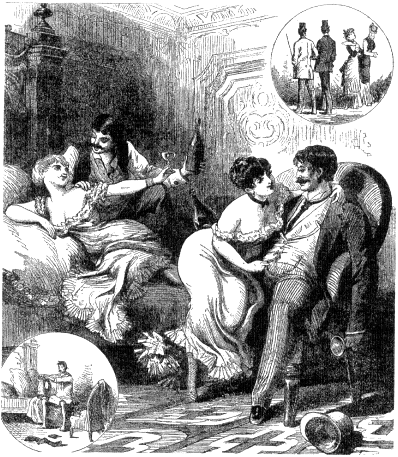
Ashamedly, I shall go by the name of Scarlet, for I was born into a life of gentility and would loathe to disclose my Christian name. If it eases your conscious to disregard my feelings, I shall duly understand, because before finding myself in such dire circumstances, I too would've judged harshly a 'soiled dove'. A sequence of misfortunes befell me: the onset of the Civil War, death of my beloved husband, and loss of home. With no kin for aid, I turned in desperation to an advertisement of easy money, whereby I'd pose in my undergarments for photographs popularly circulated amongst the soldiers.


A local madam enticed me with an even more lucrative proposition, promising me her brothel, or men's club was frequented by only the most reputable gentlemen. It was not only my stomach aching with hunger and winter's freezing nights looming that led me further down that slippery slope of damnation, but also my utter sense of grief and despair.


My very livelihood was dependent upon the selling of my flesh, and I said and did whatever was necessary to survive. I cannot fully describe the numbness I felt, nor the horror of those debauched hours.


In truth, the term 'gentlemen' could not be applied to our patrons, and my downfall, both figuratively and literally came when one of them found sport in sending me down a flight of stairs. I survived the broken bones, but the scar inflicted upon my face dramatically lowered my saleability and I became a camp follower of the Union troops.


I ended up in Nashville's notorious Smokey Row, a Sodom where hookers skyrocketed with the war from two hundred to fifteen hundred. Syphilis and gonorrhea ran rampant and some believed it was our intent to spread the diseases to the enemy troops, but I can say with painful truth, no woman knowingly takes on this plague.

-->   When I thought it couldn't get worse, Lt. Col. George Spalding, in an attempt to clean up the city, forced me, along with other 'public women', to board the steamboat, Idaho. We were sent to Louisville, but not allowed off the ship, and so sailed onto Cincinnati. Starving and ill, we eventually returned to Nashville, whereupon the well-intentioned colonel began regulating prostitution. We were medically examined weekly, licensed, and taxed, lest we find ourselves hospitalized or in the workhouse. I w I wish I could tell you I eventually found a life of redemption or a moment's peace, but my life ended in beggary and violence in the gutter, I called home. Pray do not look upon me as a faceless statistic, but rather take me to your bosom as Sister, Daughter, and Mother, and stop the exploitation of women that continues to this day.

September 5, 2011

The Iron Horse Comes to Town


written by Rosa Morgan

September 5, 1872 was a day the two brothers would never forget. They stood side by side watching history unfold before them, and yet each was experiencing feelings markedly contrary to the other.

With his hands balled into fists and his jaw clenched, Simon stared down the monster bearing down on them. It had cut a swath across the land, like a gaping wound that would never heal. Families were uprooted from ancestral homes and livelihoods lost due to its conquest. The cyclops' one eye shown ominously through the day's fading light, and its black vaporous smoke filled the air. The very ground beneath their feet rumbled with its approaching bellow, and when it's piercing whistle blew, he felt heartsick, for the peace of his homeland was forever gone.


Frederick hooked his thumbs into his suspenders, his chest was puffed up with pride, and the glint in his eyes reflected his deep satisfaction. His whole life had been devoted to developing steam engine locomotives. His interest was sparked as a boy when he read about the first American built locomotive, the Baltimore and Ohio's Tom Thumb. It was an engineering triumph, even though it had lost the impromptu race against that damnable horse and carriage. There would be no belts slipping off pulleys on this day.


Huffing and puffing with iron scraping shrilly, the The Santa Fe's train rumbled to a stop into Dodge City's newly built depot.
The band struck up and the crowds surged forward, each wanting to touch the magnificent beast. Frederick knew all too well of his brother's prejudices, but he'd hoped seeing its arrival would alter his opinion. "Isn't she magnificent? The rail and its Iron Horse is our future. We'll have efficient commerce, expansion of the West, burgeoning cities, cattle from Texas and coal from Colorado!"


Simon studied the politicians climbing the engine with their waving flags and the railroad men with their pockets bulging with profits. Congress had granted the railroad companies land all across Kansas and they in turn sold it cheaply to farmers, who would then need the train to transport their goods. He turned to his brother, "Mark Twain was woefully right when he said, 'A railroad is like a lie, you have to keep building it to make it stand."


1917 State Fair Staged Train Collision

Union Pacific